In Nicolas Roeg’s Gothic horror film Don’t Look Now (1973), a grief-stricken father mourning the death of his young daughter is haunted by a figure in a bright red jacket. While restoring a medieval church in Venice, he is tortured by flashbacks of his daughter’s drowning, eventually laying down his tools to pursue the red figure through the city’s laneways – with disastrous consequences in the form of a blade dragged across his throat.
Don Driver was an avid horror fan. His wife, Joyce, recalled that ‘a horror movie couldn’t come to New Plymouth without Don going to see it.’[1] In Driver’s assemblage Screen, the cherry red coat that dangles above a rusted saw blade probably isn’t meant as an explicit reference to Roeg’s film. Yet, both use the unexpected juxtaposition to unsettle the viewer, tapping into the dark, psychological power of everyday objects to evoke something both mysterious and menacing.
Best known as a sculptor, from the 1960s Driver made a unique and important contribution to New Zealand Modernism by transforming grungy found materials into uncanny assemblages with complex real and imaginary world associations. With Screen, objects like rusty agricultural implements, polyester belts, knotted rope, colourful clothing, plastic jugs and even a dead duck are suspended from a blue garment rack. At first glance, the placement of the objects feels improvisational – like movie props randomly gathered up at the end of a shoot. This is, of course, an illusion. The work is a masterful interplay of shapes, colour, form and texture, pushing us to see them beyond their everyday uses into a more cinematic realm of association, memory and interpretation.
Driver’s approach to materials is often connected to Robert Rauschenberg and an American assemblage tradition of sculpture. But Screen also demonstrates the parallels between Driver and directors like Roeg, whose associative, fragmented editing style discards conventional narrative structure and uses colours, objects and pattern to both propel the narrative and keep viewers in a state of unknowing. Heavily inspired by the rural Taranaki setting where he lived and worked, Driver’s ‘something-nasty-in-the-woodshed’ aesthetic and his interest in occult ritual has also drawn comparisons to folk horror classics like Robin Hardy’s The Wicker Man (1973) – which, interestingly, originally screened in Aotearoa on a double bill with Don’t Look Now.
Playing on various concepts of the screen and screening, this sculpture creates unexpected interplays between found and made objects, opening up new – or sometimes old – ways of seeing the things that surround us and the latent histories they carry. There is nothing overtly horrific in this work but the blood-red jacket, frayed twine and talon-like tools takes us straight to the movie screen and the horror film as threshold spaces between reality and fantasy open to the darker possibilities of the human imagination. With deceptive simplicity, Screen shows how Don Driver’s work is always haunted.
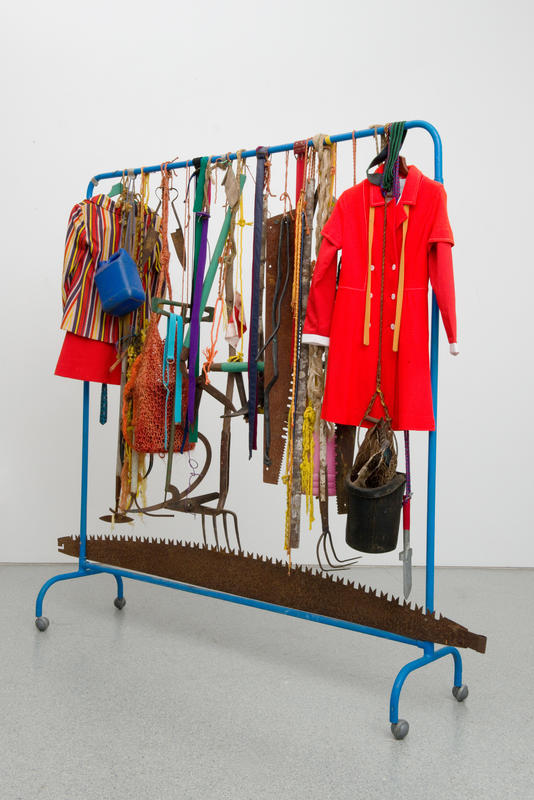
Don Driver
Screen, 1985
mixed media
2060 × 2240 mm
Chartwell CollectionAuckland Art Gallery Toi o Tāmaki
purchased 2012
Written by Curator of Screams (Aaron Lister and Dr Chelsea Nichols)
Being, Seeing, Making, Thinking: 50 Years of the Chartwell Project
The Chartwell Collection Trust and Auckland Art Gallery Toi o Tāmaki, 2025.
[1] Joyce Driver in conversation with Sarah Farrar, ‘Rites of passage: public response to Don Driver’s Ritual (1982) and its institutional history’, Tuhinga 24, 2013, p 51.

