On 24 March 2023, a large anti-trans rights rally was scheduled in Te Ngākau Civic Square in Te Whanganui-a-Tara Wellington. Situated on the edge of the Square, and at the heart of public debate, City Gallery Wellington Te Whare Toi often takes precautionary measures during events such as this. The front doors of the gallery, which open directly onto the Square, were temporarily closed. Often, this precautionary measure is practical, but on this occasion, it had never felt more symbolic.
The exhibition that lay on the other side of those doors, Reuben Paterson: The Only Dream Left, hadopened only a few weeks earlier. Bringing together work from across Paterson’s thirty-year practice, The Only Dream Left explored the kaleidoscopic complexities, contradictions and possibilities of human experience and sexuality, of conforming and non-conforming identities, as well as challenging the boundaries and rules that have been placed around all these things—and around art itself. Paterson’s riotous and provocative work asks us all to open ourselves up to other experiences and possibilities, to move through and amongst other bodies, to be, see and dream outside of the terms and frameworks imposed by others. It invites us to lie with the panther or lose oneself in the garden—and oppose all who say otherwise.
The exhibition closed its doors on this rally, turning its back upon its rhetoric of division. It didn’t need to. Counter protests in Tāmaki Makarau the day before saw the organising activist flee back to the UK, the rally cancelled in the wake of her departure. Instead, a crowd of hundreds showed up in Civic Square in support of transgender rights and our rainbow communities. The celebration that kicked off was much more closely aligned with Paterson’s work. The doors of the gallery were metaphorically flung open. A transgender flag was lowered from the window of the first-floor staff room, where it floated alongside the banner for Paterson’s exhibition. His shimmering golden tree was bound to this momentous event, seen in video and news footage taken during the day.
Like this counterrally, the wildly celebratory nature of Paterson’s work is laced with the full knowledge of ongoing battles that still need to be fought to protect our vulnerable communities, to fight for everybody’s right to control their own bodies and identities, especially in the face of the new culture wars and the rise of far-right ideologies. Twenty-one years after they were first exhibited, it’s easy to forget that Paterson’s paintings of lions, tigers and panthers were initially made as a challenge to the ‘gay panic’ legal defence. Until it was repelled by the Crimes Act in 2009, this defence was used to justify violence against queer victims based on their perceived transgressions of normative behaviour. Re-activating and twisting the predator/prey relationship this defence relied on, these works represent an earlier fight for queer rights and anti-discrimination.
Paterson’s commitment to social and political issues runs right across this exhibition. His paintings of fireworks in bruised skin tones which light up and transform the night sky were made in response to the Black Lives Matter movement. Invoking the sexualised body, astrological dark matter, and Te Kore (the realm of potential being from Te Ao Māori), these paintings are complex explorations of the power and/or control of blackness and indigeneity. Paterson’s landscapes across different media churn with elemental energies and deities, but also with the continued struggle over land rights and possession.
These artworks all reach out towards other struggles and histories. Yet, they are always incredibly intimate, full of personal conviction and aroha, shifting them outside the frame of overt politicisation. Nevertheless, these works felt especially charged during that rally, and in its celebratory aftermath. The boundaries that these works traverse exist beyond the doors of the art gallery, they stretch outwards into the realm of public discourse and multiple, complex histories.
Paterson watched from afar as these events unfolded, interested especially in their physical and symbolic proximity to his exhibition. One sanguine comment he made has stuck with me: ‘I wonder what would have happened if she stepped into the exhibition?’ This is one of those ‘what if’ possibilities that sits behind so much of his work. His is a practice which believes in the potential of change and transformation, which is generous and accommodating of other perspectives, but is prepared to strike when it needs to. Did Paterson hope that this experience might have let the rally organiser see or think differently? Or was he dreaming of confrontation—that his works might rise as one to swallow her whole? In the end, they didn’t need to. The weight of public opinion and shifting discourse chased her away before the bear, tiger or the rainbow had to.
The events surrounding the failed rally cemented the relationship between The Only Dream Left and Te Whanganui-a-Tara Wellington that had been emerging since The Golden Bearing (2014) started growing to gasps of awe and bewilderment in the gallery foyer in the weeks prior to its opening. This sculpture of a giant gilded tree transformed the experience of this space, and the promise of what might happen within. The Golden Bearing foreshortened the foyer gallery, turning all three ground floor galleries into a single entity stretching beneath its canopy. This metaphorical canopy extended beyond the impressive four-and-a-half-metre span of the tree’s physical canopy, which seems to climb between floors through an architectural void. You could almost sense its roots reaching down through the basement into the reclaimed land that the gallery sits on.
The Golden Bearing was always going to be deployed as a wayfinder and navigational aid within the exhibition, directing visitors to what could be seen and experienced in physical space, but also through the invisible realms and cosmologies that Paterson’s work opens up. We didn’t anticipate that those roots would metaphorically stretch outside of the gallery, becoming a beacon of hope and transformation within the currently barren space of a Te Ngākau Civic Square undergoing substantial redevelopment and rebuilding. This power was most strongly felt in the still and silence of the night. As darkness descended, it cloaked the harsh reality, pulling all attention towards the tree of golden glitter glowing brightly inside the gallery. Face and handprints regularly wiped off the gallery’s front glass door testify to this gravitational nocturnal pull of the sculpture, and the transformative powers of art.
The sculpture performs differently than it had during its first outing, when it magically materialised one day in Ngāmotu New Plymouth’s Pukerua Park in 2014. There it brazenly and campily planted itself within the natural environment—albeit a highly crafted and composed one. In Te Whanganui-a-Tara, in contrast, it sits within a gallery inside an urban precinct built from sand and stone. This is a space that is highly vulnerable to rising sea levels and earthquakes, yet ‘connects’ with nature through a patch of artificial turf, a couple of grass strips laid over the concrete, a ‘living wall’ that is currently stuck behind a construction fence, and a line of real trees patrolling the edges of the Square that somehow feel more performative and ‘fake’ than this sculpture. The Golden Bearing corralled all of these energies around itself for the duration of this exhibition, both queering and indigenising this public space from the inside out. This is a sculpture that firstly invokes and then moves through the gardens we grow, the buildings and cities we dream of and construct, and the stories that have been told about them across time and cultures.
The Only Dream Left stretches out of the gallery into Civic Square and the city, but also draws energies back from it. Koro (2023) is a new sculpture of a crystal-encrusted conch that reflects orbs of rainbow-tinged light around a shadowy gallery space. It honours Paterson’s grandfather Jack, who operated a sand mining business in Matatā in the Bay of Plenty. Jack is present in all of Paterson’s work through the multiple connections he forges between his personal whakapapa and the whakapapa of glitter—both of which essentially return to sand. Koro specifically embodies the material knowledge, histories and energies that connect and swirl around the two Patersons.
A family member’s recollection provided the final link Paterson was searching for to anchor the sculpture in this combined whakapapa and on this whenua. He was reminded that Jack’s Scottish grandfather, John Paterson, was a well-known builder of early Wellington. In 1902, John was awarded the contract to construct the Town Hall—located directly across the Square from City Gallery Te Whare Toi. This earthquake prone building was closed in 2013 and is part of the crumbling urban precinct that The Golden Bearing temporarily transformed. Paterson was able to secure a piece of concrete rubble from the Town Hall and lodge it invisibly under Koro’s plinth. This brings together that whakapapa of materials: sand, shells, concrete and glass, as well as the three generations of Patersons who connect through them. Koro refracts across the worlds they have built and continue to build—material and immaterial, natural and urban, from far away and just across the Square.
Koro is a transmitter of all these histories, cosmologies and forces. It also calls back across space and time to another of Paterson’s recent sculptures. Guide Kaiārahi is a ten-metre high crystal waka pītau currently hovering above a reflection pool on the forecourt of Auckland Art Gallery Toi o Tāmaki. Guide Kaiārahi itself calls back to other things, including the metaphysical abstractions of Māori artist Ralph Hotere who this site was originally made for, but especially the phantom waka of Te Arawa legend that heralded the eruption of Mt Tarawera in 1886. One of the impacts of this eruption was the forcing of Paterson’s iwi Ngāti Rangitihi to relocate from inland to coastal regions such as Matatā. A century later, Matatā provided at least the metaphorical sands used to make Koro.
These connections are all made possible through the sculptural marshalling of a language of light, reflection and the animating power of breath that grants life to all forms. Here, the breath specifically alludes to the moment Guide Kaiārahi came into being with the blowing of a Pūmoana at the sculpture’s dawn blessing. The lights, that had stubbornly refused to turn on until that very second, suddenly sprung to life, activating all of the forces and energies that the work embodies: natural and supernatural, seen and unseen. Paterson did not know this yet, but this was the moment when Koro was called into existence.
Koro and Guide Kaiārahi call out to each other and embody the power and possibilities of Paterson’s recent practice that have become sharper with his push into large scale sculpture. Those sculptures: the glittering conch, the golden tree and the erect crystal waka have opened new spiritual and esoteric paradigms. Guides to other realms and modes of knowledge, they hold out the promise to move us through worlds beyond our own. This is less a sudden awakening than it is a new way of manifesting these possibilities. Paterson’s glitter paintings have always held and reflected other worlds within their prismatic surfaces. They use light and reflection as a metaphor for spiritual possibilities, and always encourage the viewer to move beyond material and surface effects to experience something outside of the work and also themselves. The new sculptures charge space and experience in different and even more profound ways. They put us within the rainbow or the beam of light, and all the possibilities these can represent.
Paterson argues that the world and art discourse have changed alongside his work. He feels that both are now far more open to these speculative, esoteric possibilities than at any point throughout his career, and that he can finally put forward such propositions and have them taken seriously and treated respectfully.[1] His work has been subject, and sometimes subjected to, long standing, and, at times, uncomfortable, discussions around queer and Māori, or queer Māori, identities and histories—often framed through the relationship between camp and whakapapa. Yet, the spiritual dimensions of his work have been downplayed, even though it is the element that underpins everything else.
***
The Only Dream Left steps into this space. It starts with the propositions issued by Paterson’s new sculptures and uses these to re-present and test understandings of his entire practice. Presenting a relatively tight selection and small number of works to draw out the breadth of ideas animating his practice, it is a stripped back and almost minimalist exhibition for an artist who sometimes seduces with abundance and luxuriance. At its heart the exhibition calls for visitors to move beyond an appreciation of glitter as a material and understand it instead as metaphor, as something that opens up a world of other possibilities beyond those we might just see. He calls it ‘glitter growing up’.[2]
Despite all protestations on the gallery wall text, this is a survey — at least in the sense that it brings together almost thirty years of work. But it resists the survey as a mode that seeks to historicise and lock down stylistic shifts and developments. The exhibition looks backwards in order to emphasise the forward momentum of Paterson’s work, the multiplicity of ways it operates in the present, and specifically through the new lens provided by his recent sculptural turn.
When the Sun Rises and the Shadows Flee (2005) is the earliest work included in The Only Dream Left. This breezy, shimmering beach scene both invokes and pushes against the fantasy of a South Pacific paradise. At the time of its making, it represented a radical shift in terms of upscaling and moving beyond the materiality of glitter. Shimmer disks from billboard advertisements replace glitter as the core material, activated by a gentle breeze produced by an industrial fan.
Paterson here appropriates the technologies, forms and languages of advertising and film to both present and parody that romanticised, picture-postcard image of a South Pacific beach scene designed to seduce tourists and dreamers from other cultures. This landscape of light and seduction is quickly transformed into one of darkness. The work invokes the realm of Hine-nui-te-pō, the atua of the night and recaller of the dead. It is a reflection on the passing of Paterson’s father, overlaid in the artist’s memory with his first visit to Rarotonga. The work unites these different forms of journeying and the ways we process such events.
In the exhibition, When the Sun Rises and the Shadows Flee stands with Paterson’s new sculptural work. It is offered as an early articulation of Paterson’s desire to push his two-dimensional painterly language into a three-dimensional sculptural/metaphysical one to open portals to other realms of existence. The installation moves us between the living and the dead, as well as different cultural understandings of this passage. The black silhouetted palm trees with their leaves shimmering in the fake breeze feel intimately connected to The Golden Bearing and the role it plays as wayfinder between multidimensional realms.
The oldest work in the exhibition also speaks to the newest, via a shared language of light. The reflections from those shimmering discs meet and intermingle on the gallery floor and walls with the refracted bursts of light and rainbow colours cast across spaces from Koro’s crystals. In an affront to conventional curatorial practice which strives to ensure that each work is locked into its own space and that light, reflection or sound spill across different works is minimised or eradicated, this exhibition welcomes these moments as animating energies that impart beauty and wonder. Much of Paterson’s practice now exists in these immaterial and often uncontrollable elements that sit outside of the art object.
This shared light language brings together the past and the present of Paterson’s art, bridging the almost twenty years that separate these two works. It also connects the material and immaterial realms they cross, and the specific but linked whakapapa they invoke. In this shared light we can see these works as both connected and deeply spiritual. This is especially liberatory for When the Sun Rises and the Shadows Flee. Over time, this work has tended to be discussed primarily in terms of experimentation with materials. For so long an outlier in Paterson’s oeuvre, it now feels at home among the recent sculptures. It is a surprise to discover that it is the oldest work in the show. In turn, it lets us see that the metaphysical possibilities held within the recent sculptures have been embedded within Paterson’s work across decades and within different media.
Another older work is found here in new form. The exhibition includes two of the four groups (or eight of the sixteen panels) from the Whakapapa Get Down Upon Your Knees project, commissioned for the Asia Pacific Triennale in 2009. Paterson made the most of this opportunity and the grand spaces of the Gallery of Modern Art in Brisbane to present a staggering eight-meter square kaleidoscopic work that dwarfed the viewer, to convey the vast scale and workings of whakapapa. Made up of interlocking parts, this is another work that hovers in that physical and conceptual space between painting and installation.
The two parts are presented in different ways in this exhibition. One is stacked in a vertical two by two formation, the other hung as a single horizontal sweep. They are also split across different galleries. They hold the edges of the exhibition, and, as in the original full work, serve to direct and force its energies inwards to create a kaleidoscopic entity. The exhibition took its shape and operation from this painting.
Through its red, white and black colour scheme, and its use of koru, kōwhaiwhai and especially the Te Arawa pūhoro pattern, the first of these paintings connects directly to Paterson’s paternal line and Ngāti Rangitihi whakapapa. The second invokes Paterson’s maternal Pākehā lineage by re-imaging the floral patterns of his grandmother’s dresses and a 1960s colour palette of pale blues. Always working to celebrate the power of hybridity in all things and especially in himself, Paterson mixes and remixes these forms and lineages. The central pattern in the first painting may look like it has come from toi Māori but is, in fact, based on the designs and fabrics of Italian fashion house Pucci that dominated global fashion through the 1960s. The flowing, abstract forms and colours of the second set speak to a recent moment of 1960s fashion as well as the concurrent Māori modernism of artists like Sandy Adsett.
These latter four panels sat at the corners of the original larger work, capturing the energies of the other parts and pushing them outwards into our space and time—another take on the central journeying metaphor. Wanting to reenergise the potential of the work, Paterson enacted another swift change by reordering the panels just before they were to be hung on the wall. New patterns and energies emerged out of this shift. There were suddenly more overt references to the landscape, especially the linking of earth, sea and sky, and also connections to customary tāniko designs of weaving practices. In opening new relationships firstly within and then between these two sets of works and those maternal and paternal lines they carry, this reconfiguration generated something even more open and vibrantly kaleidoscopic.
The Only Dream Left is a place of making and unmaking, an imaginary playground of open-ended rather than closed experiences. The exhibition grants agency to visitors to engage on their terms and opens space for the wide range of potential encounters and experiences with Paterson’s work. It does this by reaching into the work itself and harnessing strategies that Paterson has put to play and continued to test over thirty years. The exhibition feels and moves like Paterson’s art, as opposed to just showing it.
Paterson’s long-term practice of pairing was quickly adopted as curatorial strategy. Throughout his practice he has regularly set up direct relationships between two distinct things to facilitate an exchange that opens up multiple possibilities. Binaries are invoked in order to blow apart faith in any form of binary knowledge. There is always a third or fourth pathway in Paterson’s work and inside this exhibition. It includes couplings that Paterson has previously made within his work, some made for the exhibition, and the inevitable and often most valued ones—those chance or unexpected relationships that surface through these processes. Paterson uses pairings to keep his work open-ended, and also to let others become active participants within it—a key part both of his collaborations with other makers and the invitation his work offers viewers.
The exhibition pairs The Golden Bearing for the first time with the digital animation Te Maiea (2020), a whakapapa of the sands that is recited like a visual mihimihi. The pairing was based on an understanding of the shared power of these works to transform the white cube space and transport the visitor elsewhere, but in entirely different ways. Visitors approach, then walk around the sculpture and into the imaginative realms it crosses, while the rhythmic pulses of Te Maiea are felt—visually, bodily, and, despite or because of its silence, aurally. Both also come together as powerful Te Ao Māori creation stories expressed across different mediums and materials. They each transport us back to the creation of Te Ao Mārama (the world of light and life) through the separation of Papatūānuku and Ranginui.
Te Maiea comes with a more direct invitation. It asks visitors to pair their music to its visuals, to find correlations between sight and sound that can transport them further into the experience of the work. The user-generated soundtrack the animation has generated clocks in at over seven and a half hours. You would need to watch Te Maiea almost one hundred times to hear the soundtrack in its entirety. This invitation to become an active participant inside Paterson’s work and give oneself over to its synesthetic dimensions has been well and truly taken up—in what feels like a metaphor for the entire exhibition.
Music and sound are essential elements of Paterson’s practice. This is an artist who often titles works and exhibitions after recalled lyric fragments (‘The Only Dream Left’ is a song by New Zealand band the Verlaines), describes the relationship between his shimmering paintings and their viewer as a dance, and ‘hears’ and encourages others to listen to his paintings. A silent disco staged as part of a late night public programme tapped into Paterson’s blending of sensory modalities. Revellers danced within the reflected pulsating lights and energies of Te Maiea to a history of queer dance music performed by DJ Elastic Coitus — the very music that fed into the making of much of the work in this exhibition.
The life-size glittered bear David (2012) acts as another gateway to this exhibition-as-imaginary-playground, while being equally mesmerised by the experience. Paterson has long deployed David as a stand-in for the gallery visitor. He is always placed in direct relationship with another artwork, and often looks lost or bewildered in the gallery context—its fault, not his.
David here stares into space or dreams of others. Another newly made pairing places him on an elaborately-designed carpet carrying Paterson’s kaleidoscopic and floral imagery. This is a collaboration between Paterson and Sudi Dargipour, head designer at Dilana rugs and an expert in Persian design. The carpet is made with traditional Persian hand-knotting and burnt pile techniques that reveals layers of gold and glitter that sit beneath the surface—speaking through Paterson’s imagery, but also to his approach to materials, and broader interests in cultural exchange and the meeting of old and new knowledge systems. This type of carpet was traditionally reserved for royalty. It is a fitting stage for a sculpture named after a homoerotic Renaissance nude and a gay shorthand for a particular type of body, who is actually scaled to the size of a female brown bear.
David feels anything but lost or conflicted in The Only Dream Left. He feels at home, as though the gallery and the art experience has finally reorientated itself around him and the interests, experiences and the communities he represents. His face, which once looked bewildered, now reads as an expression of empowerment and pride. He is no longer just a stand-in for the gallery visitor. He represents anybody attempting to make sense of their relationship with their body, desires, cultures, their place in the gallery or in the world. In turn, David stands for (as well as on) Paterson’s work which has played such a major role in forcing these changes and opening these new possibilities—letting us all see things differently. David has earned the stage that the carpet and this exhibition provides him. In recognition of all these spiralling possibilities, Paterson decided to rename the sculpture on the fly during a public talk. It now goes by Kings and Queens.
***
If Kings and Queens has come to represent the exhibition, this publication might be paired with the glittery sculptural snake known as Laocoon (2014) that slithers across the floor in an adjoining gallery. The pistachio-coloured snake slinks away from a painting made of exactly the same material and hue as itself in search for something more, for something outside of itself.
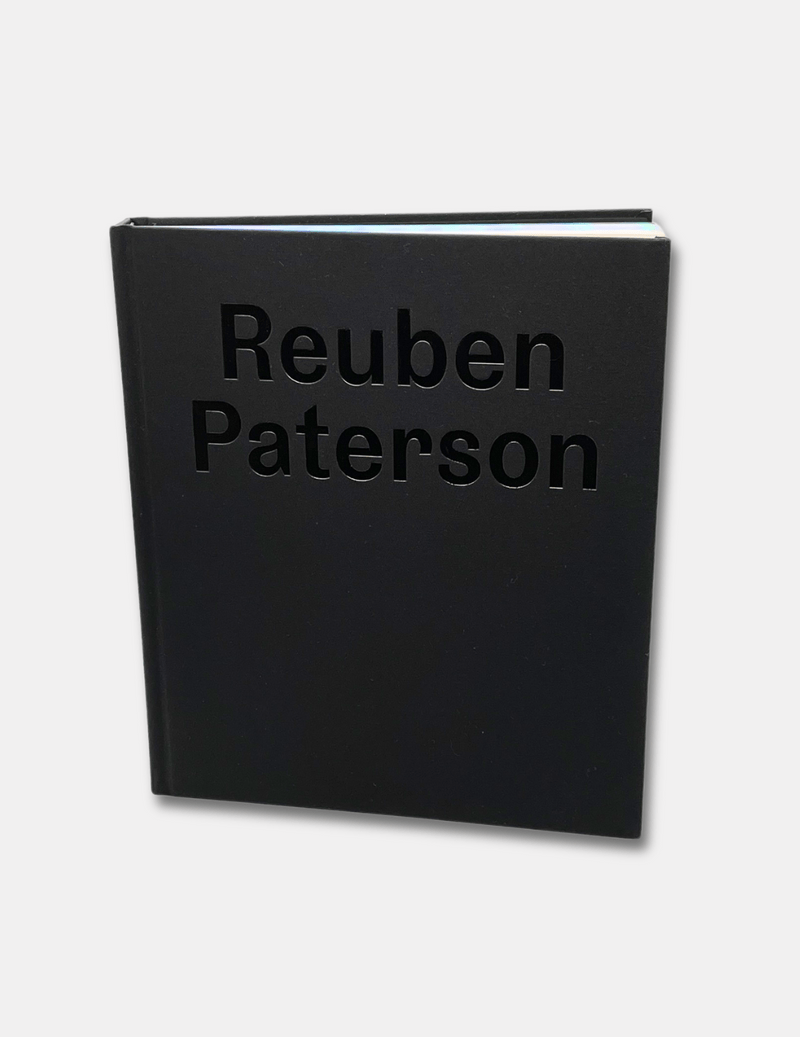
The first part of this publication is grounded in the exhibition: this essay, installation shots, and a collection of responses and reflections on Paterson and his work gathered from speakers who contributed to opening weekend talks. It then slithers outwards into more expansive texts written by Geraldine Barlow and Karl Chitham that take a wider perspective on Paterson’s work, exploring its elemental and queer perspectives and histories respectively. An artist’s project is also embedded within these pages. Paterson has paired all of the plates, bringing together images from across his practice. Some of these pairings are pre-existing, but most are newly imagined and contribute to the project’s goal of re-thinking and re-presenting connections between and across all of his work. We are also greatly honoured to have a new text by Witi Ihimaera, who firstly accepted the invitation to speak at the opening of the exhibition, and then to write in response to Paterson’s art—to which he has always been a rich source of inspiration. The Paterson/Ihimaera pairing is one of this project’s greatest achievements.
This publication is a gathering of fresh perspectives and energies around Paterson’s art. Its contributors rise to that challenge his art extends to all who encounter it—to take it on and approach it on their own terms and with imagination. Extended Whanau’s design, Cheska Brown’s installation shots, and the behind the scenes work of editor Kirsty Baker and researcher Bridget Webber all less work on Paterson’s practice than with or through its energies. The same applies to the City Gallery Wellington Te Whare Toi teams who first brought the exhibition to life in the planning and installation stages, stood within and looked after it and its visitors through its duration, and kept extending its reach through promotion, education activities and public programmes.
There is a collective force or momentum at play here that reflects a core element of Paterson’s work. His current practice is driven by the need to break through the frameworks that have been put around his practice, his identity, his successes, and, most definitely, his signature material of glitter.
The forward-looking emphasis of this exhibition has also been propelled by Paterson’s relocation to New York City. In another of those moments of synchronicity, this was a decision made just before the offer of this exhibition was put to him. Paterson’s drive and ambition to leave Aotearoa and make it in the most cutthroat of international art centres is probably the ultimate dream referenced in the exhibition’s title.
This project dares to dream with and alongside him.
[1] Andre Chumko, ‘All that glitters. Major Reuben Paterson Exhibition Opens in Wellington,’ The Dominion Post, 25 February 2023.
[2] Joanna Wayne, ‘Shooting for the Stars: Reuben Paterson’s Dazzling Crystal Waka is finally Unveiled,’ The New Zealand Herald, 10 July 2021.
Published in Reuben Paterson, City Gallery Wellington Te Whare Toi, 2024
 AARON LISTER